
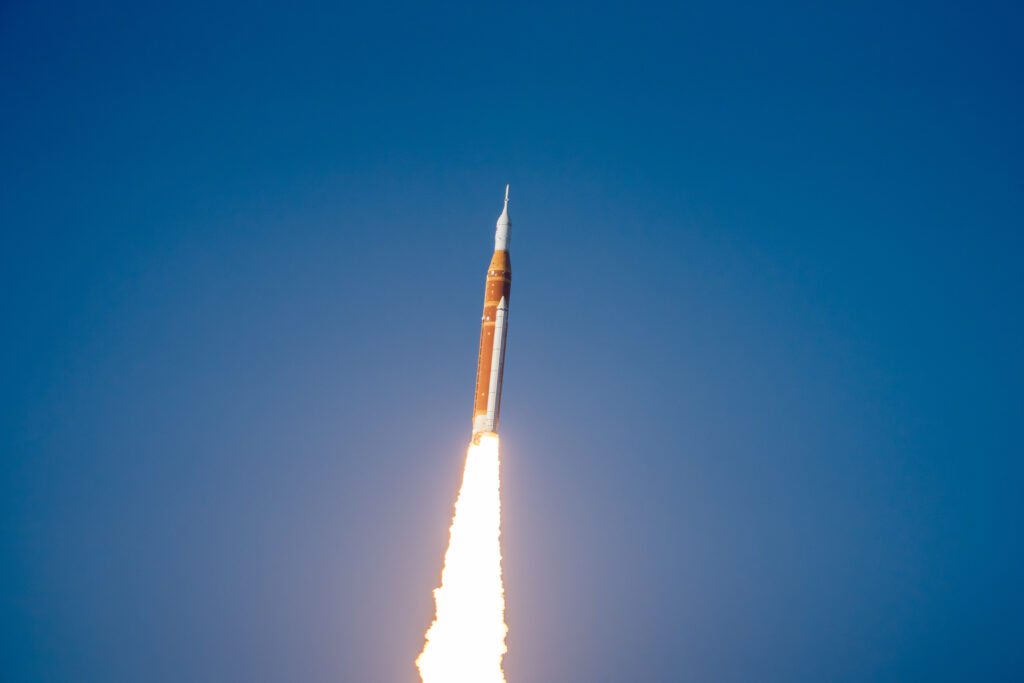
On April 1, the United States launched a rocket into space containing astronauts on a mission to fly around, but not on, the moon. This mission, named the Artemis II, marks a massive milestone in space exploration, since NASA is sending a rocket with astronauts deep into space for the first time since the Apollo 17 mission that took place in December 1972. It is a very important mission, designed to test critical systems implemented in the Artemis II to pave the way for future moon landings. The mission returned to Earth on April 10.
The Artemis II carried a crew of four astronauts aboard an Orion spacecraft, NASA’s deep space vehicle, designed with the purpose to carry astronauts beyond the Earth’s orbit. It is a central component of the Artemis program, allowing for the crewed missions to orbit the lunar surface of the moon with the goal to eventually reach Mars. Unlike its predecessor, Artemis I, the Artemis II is the first crewed test flight of this developed Orion spacecraft.
The difference between this mission and the Apollo 17 mission back in 1972, is that this spacecraft did not land on the Moon. It instead sent the crew of four on a journey around the Moon and then returned back to Earth, allowing for testing of navigation, life-support systems and communication.
After initial launch, Artemis II had orbited the Earth before performing a “translunar injection burn” which propelled the spacecraft toward the moon. The crew then flew freely through space, where they aimed to loop around the moon without entering its lunar orbit, and are now returning to the Earth after completing its loop. During the 9-day mission, the astronauts tested the onboard systems in the rocket, conducted scientific observations of the space and evaluated their own bodily functions in deep space conditions.
The Artemis II mission is a significant step towards the Artemis III mission, which intends on landing astronauts near the Moon’s south pole. Artemis III, which is scheduled for the late 2020s, plans to land two different astronauts on the Moon’s surface in order to test updated life-support systems, space mobility tools and resource utilization methods that will be critical for future expeditions to Mars. The crew expects to spend roughly a week on the surface of the moon.
This journey that the Artemis II went through was roughly 230,000 miles in order to get to the moon and then travel that exact same distance back to land in the Pacific Ocean after completing its trip. Throughout the trip, there were a few dangers that were being reported, one such being the extreme thermal conditions that could have been imposed on the astronauts in the ship are safety regulations to be ignored. However, this is why NASA deemed the Artemis II a necessary mission, to discover all the issues with this mission in order to fix them before another moon landing can take place. Overall, the Artemis II mission went very well, with many successes being reported.