
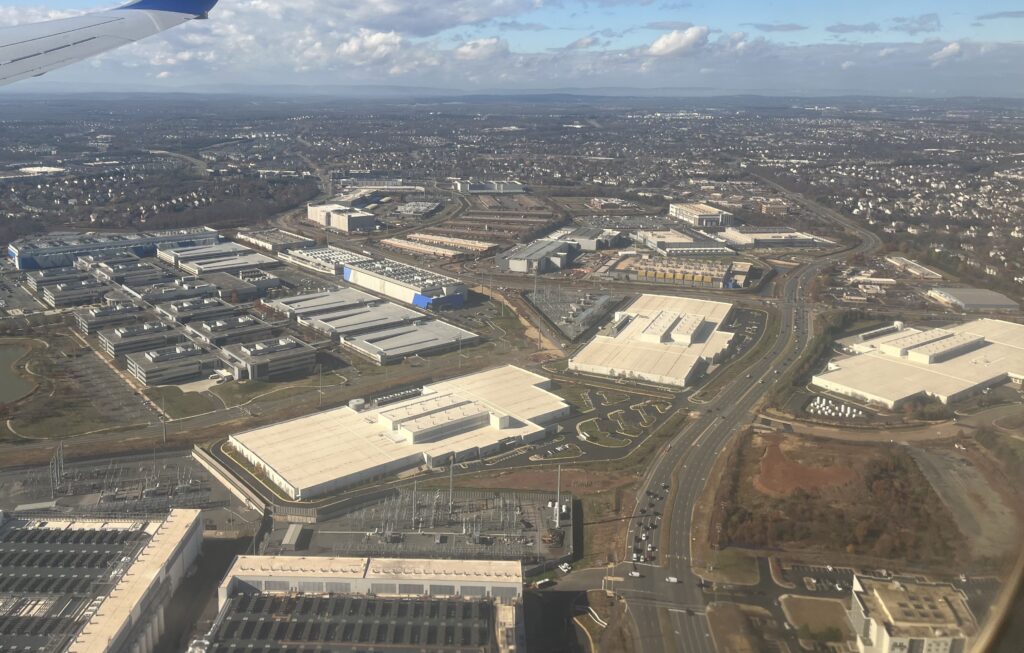
As demand and use for artificial intelligence has rapidly risen in the past year, the companies that support this new technology innovation are attempting to keep up by constructing new data centers to support AI’s growing needs.
The poster child for data center development has been Loudoun County, Virginia. Home to more than 200 data centers, this northern Virginia County has been dubbed “Data Center Ally.”
County officials praise the significant tax revenue that the data centers have brought in. In 2026, the estimated revenue generated by data centers for Loudoun County will be more than $1 billion. This significant revenue source is due in part to Virginia’s tax code that allows for taxation based on the value of the computer servers stored inside the centers.
Data center developers have begun expanding construction to other states including Pennsylvania, but the futuristic infrastructure has not been met with open arms in some communities.
Opposition to new data centers has pointed to the large quantities of electricity required to power data centers and similarly large amounts of water needed to prevent servers from overheating. This massive energy demand has been credited with increasing utility rates in areas with operating data centers.
In Pennsylvania, and other states, locals have banded together to stymie data center construction. Since data centers are a relatively new phenomenon, many borough zoning codes lack regulations or allowances regarding data centers and their construction.
Last September, residents of Blakely, Pennsylvania successfully pressured one developer to withdraw plans for a data center in a currently forested area of the borough that also lay next to residential neighborhoods. The borough has since passed an ordinance to strictly regulate any future data centers and confine them to a singular section of the borough.
It is not uncommon for developers to purchase land that is not zoned for industrial use because it is cheaper and petition municipalities to change the zoning. Some cases have seen small boroughs and townships threatened with costly legal action if they do not approve data centers.
Last year, Saline Township, Michigan reversed its decision to block a data center’s construction after the company threatened to sue the small township. The borough council of Springdale in Allegheny County, Pennsylvania. also begrudgingly approved a data center, believing they lacked both legal resources and standing to oppose it.
Beyond the grassroots of municipal zoning hearings, concerns about AI and data centers are becoming more politically potent at the national level. Sen. Bernie Sanders (I-Vt.) recently proposed a moratorium on new data center construction, citing the potential for AI to replace many American workers.
Active and potential candidates for political office are also making their stance on underregulated data centers known, but their skepticism is countered by government officials who believe data centers will better the economy and provide jobs. The construction of a data center typically employs 1,000 workers, but once operational, it will only employ less than 50 individuals.
Juxtaposed to the localized opposition to data centers and AI, President Donald Trump has openly embraced AI as an economic tool and signed an executive order in December that sought to prohibit states from enacting their own AI regulations.
In the meantime, data centers will continue to be a source of contention between those who will prioritize AI development and those who want to control their local quality of life.