Elizabethtown College students will be participating in two academic research symposia in the coming months designed to enhance students’ scholarship in their respective areas of study.
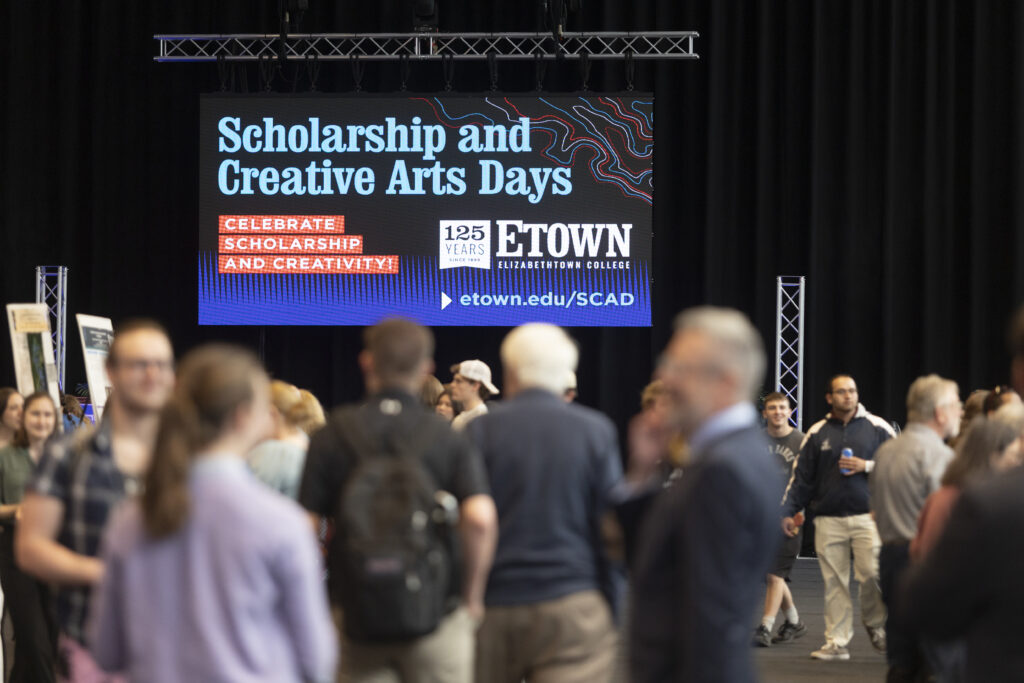
The College’s 19th Annual Scholarship and Creative Arts Day (SCAD) will be held across campus from April 20 to April 21, featuring creative works and research projects from students across academic disciplines. Students’ academic work will include poster exhibits and presentations about their research. Creative works will be on display during a juried art show and various recitals.
The primary focus of SCAD will be the original research conducted by students within their major or other field of study. Students are supervised by a faculty member through the process of constructing and presenting their research. Among the students expected to participate in SCAD this year are those in Professor Jean-Paul Benowitz’s Elizabethtown History: Campus and Community class.
“The most important thing about SCAD is the opportunity to share the [students’] original research,” Benowitz said. “It is that way to condition you and prepare you for academic life where we share our findings.”
Every year SCAD hosts interdisciplinary sessions with different themes. This year’s themes are listed as sustainability, community engaged learning and improving the human condition.
SCAD will also feature a keynote speaker. This year’s keynote and recipient of the Ranck Prize for Research Excellence is Dr. Kirsten Johnson, professor of communications, who will deliver remarks in Gibble Auditorium on the morning of April 21.
The window for SCAD proposals is currently open until Feb. 28. Applying students need a faculty sponsor to participate.
Not to be confused with SCAD, the Summer Creative Arts and Research Program (SCARP) is an opportunity for students to conduct independent research with the aid of a faculty member over the summer. Participating students receive free room and board and a stipend during the four-to-ten-week period with SCARP. It also counts towards one of the two required Signature Learning Experiences for students.
“I think SCARP is an excellent opportunity for students to prepare themselves for the workforce or graduate school, whichever they are intending,” Assistant Provost Dr. Susan Mapp, who oversees SCARP, said. “They can dig into an area of interest under the mentorship of a faculty member and expand their research skills in their chosen field and receive a salary for their work.”
The application window for SCARP 2026 closed on Jan. 30. Mapp says that this year’s applicants are still being assessed for approval. Last year saw 32 students accepted into SCARP, researching and developing projects in a variety of fields, ranging from neuroscience to engineering and historical research.
“This past summer, I worked with Makenna Snyder on a project examining the relationship between auditory cortex structure, language processing, and aging,” Dr. Jennifer Wittmeyer, director of neuroscience and SCARP 2025 mentor, said. “The goal was to better understand whether structural differences in auditory regions are associated with behavioral performance in older adults, extending prior research that had focused primarily on functional brain activity.”
For students like senior Makenna Snyder, SCARP serves as a beneficial experience providing them with an opportunity to apply their studies to an actual project.
“Being able to get in depth and hands-on experience with data coding and data analysis, as well as being able to work with real MRI data, was an opportunity that has benefitted me greatly,” Snyder said. “Having this experience on my resume and CV has made me a strong candidate for future research roles and graduate applications.”
Junior electrical engineering major Emmanuel Attah has done SCARP the past two summers.
“I have had really positive experiences doing SCARP—it was one of the ways that I was able to get into research and discover that,” Attah said. “I was frankly surprised to have such an opportunity at a smaller school.”
In 2024, he and Dr. Brenda Read-Daily conducted a feasibility study for powering the campus via solar energy. This past summer Attah, fellow junior Lilith Wright, and Dr. Mark Brinton were a part of a team with the University of Utah developing prosthetic technology that mimics the feeling of touch.
“A lot of students don’t get the opportunity to do research,” Brinton said. “I think SCARP is good because it provides students that type of environment and opportunity.”
Students in SCARP present their projects every year at the annual Landmark Summer Research Symposium which will be held at Goucher College on July 16.