
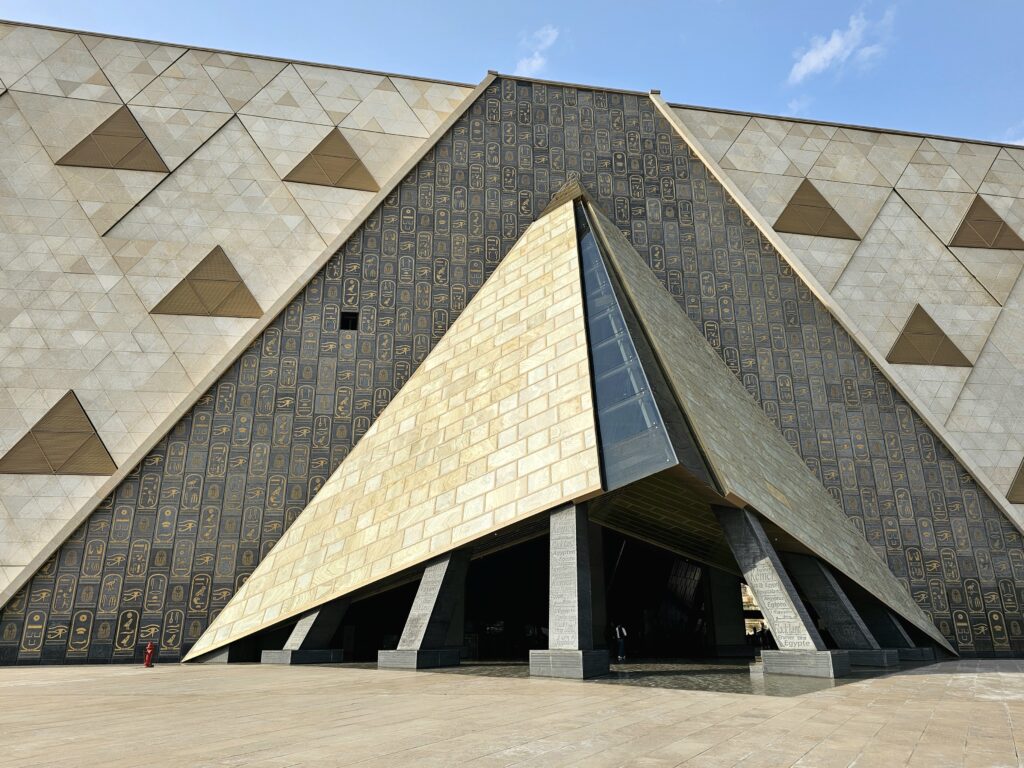
On Nov.1, the grand unveiling of a multi-decade project in Egypt has seen huge success, drawing in crowds of tourists as well as multiple leaders from around the world. According to BBC, the 500,000 square mile museum, roughly the size of Vatican City, was worth around $1 billion to build and is Egypt’s new center piece to highlight their cultural significance. There is no debate over the importance and impact Egyptian culture has had in the world, however the issue has been that Egypt’s main museum has been less than adequate to house everything.
This has led Hosni Mubarak, a previous president of Egypt, to push forward an initiative to build a newer, larger museum in 2002. The design of the monumental sized building came from the winners of a design competition, Heneghan Peng Architects, an Irish architectural design company, who happily designed an expansive display of Egyptian influence and provenance. However, history would not serve the construction of this building well, as the process would be delayed by multiple revolutions of the Arab Spring movements, internal crises, a pandemic and financing issues.
Through these setbacks, the teams pushed through and are set to do a full public opening on Nov. 4 to the excitement of millions. This display of cultural significance is set to rival and stand with the giants of the Louvre, the British Museum and the Metropolitan Museum of Art. The numbers are already supporting this as it is expected to bring in five million visitors annually, a healthy start compared to the Louvre’s 8.7 million in 2024, the British Museum’s 6.5 million and the Metropolitan Museum of Art’s 5.7 million.
The Museum’s draw is a collection of artifacts spanning thousands of years going from pre-dynastic history to up to the shared period of time with the Greek city states and the Roman Empire. However, the biggest draw to the display has to be the full showcase of Tutankhamun’s tomb, fitted with all 5,000 artifacts found in the tomb, a feat yet to be done as it simply would not have fit in the previous building.
However, the museum is not complete; in an interview with BBC, Dr. Zahi Hawass, the former minister of tourism and antiquity along with many Egyptologists argue for the return of many Egyptian artifacts to their proper resting place. High on their list is the Rosetta Stone, housed in the British Museum, the Zodiac in the Louvre, and the Bust of Nefertiti in Berlin. All of these artifacts being missing is the result of the stain of colonialism, and the opening of this new display is meant to open the door for the return of the objects with a hope of little difficulty. So far there have only been petitions, with the British government claiming to have heard no request of the Rosetta Stone’s return, however as time goes on and as these petitions gain support, there is hope for a successful return.
Regardless, this has not stopped the excitement over the new museum, which has attracted multiple world leaders to come and pay their well wishes and congratulations to the Egyptian success. Some of the visitors were Egyptian President Abdel Fattah al Sisi, Spain’s King Felipe, Germany’s President Frank-Walter Steinmeier, Dutch Prime Minister Dick Schoof, Hungarian Prime Minister Viktor Orbán, and the president of the Palestinian Authority, Mahmoud Abbas.
There is hope that this new museum will help to bring a new sense of diplomatic cooperation and a reviewed spirit of cultural appreciation worldwide.