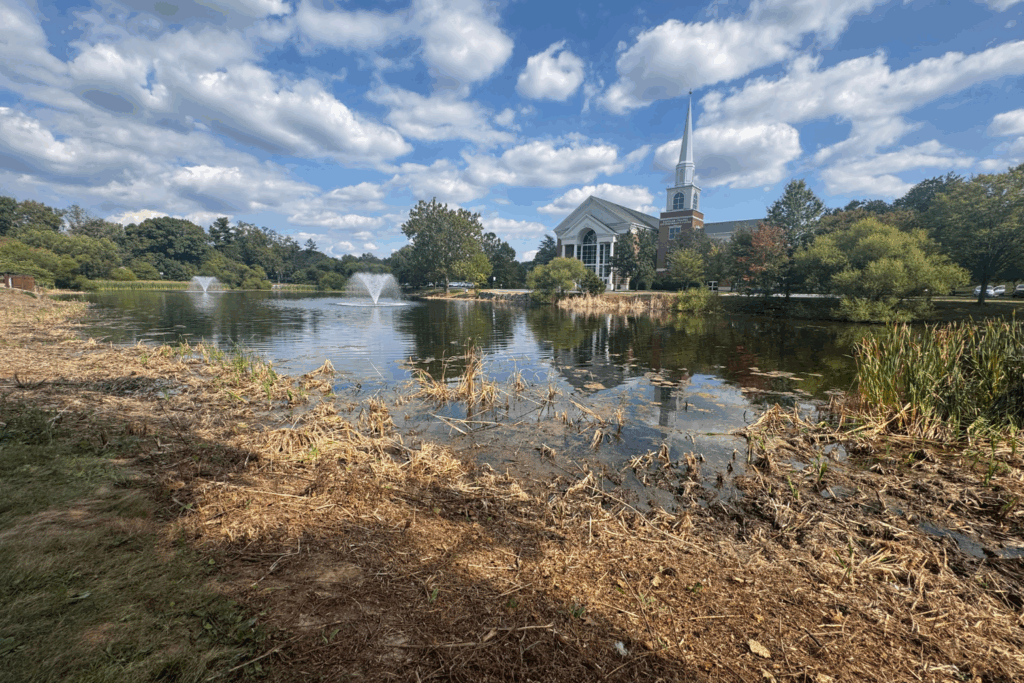
The sudden removal of vegetation along the banks of Lake Placida has raised questions among faculty, students, and alumni about the ecological and educational impact of the decision, as well as the lack of communication surrounding it.
In late August, contractors hired by the College cleared the north banks of the lake, cutting down cattails, milkweed and other plants. On the south side, near Leffler Chapel, vegetation was also removed to address clogged stormwater pipes. While that work was tied to infrastructure maintenance, the complete clearing of the north side seems to have been made for aesthetic reasons.
The extent of the removal surprised many in the campus community. Several faculty members said they first learned about it after it was already underway. “It was brought to my attention [that] it was happening when an alumni called me up,” Professor and Chair of the Department of Biological and Environmental Studies Dr. David Bowne said.
The clearing has ecological consequences that go beyond appearance. The tall vegetation previously provided habitat for pollinators and monarch butterflies, helped deter Canada geese from settling along the shore, limited soil compaction from foot traffic and reduced runoff into the water. Without that buffer, faculty worry that erosion will increase and the health of the lake will suffer.
Students have also noticed the sudden change and expressed disappointment. For some, the removal has created confusion about why the decision was made, while for others it has raised serious environmental concerns. “As an environmental science major, I am extremely concerned about the environment they have created surrounding the lake,” Samantha Murray said. She pointed to the loss of habitat for insects and pollinators, as well as the likelihood that Canada geese will now settle around the shoreline.
Lake Placida has long been used as a “natural laboratory” for environmental science courses, where students conduct research on biodiversity and water quality. Faculty have said the sudden change disrupted those activities. In one instance, a professor had just highlighted the vegetation as an example of effective land management practices, only to find it cleared by the end of the week, forcing a quick revision of lesson plans.
While some plants, such as cattails in the water, are already beginning to grow back, the long-term plan for the banks remains uncertain. Faculty members are urging the College to include ecological and educational considerations in future decisions. “Our interest is really to have a dialogue and to not only be informed, but be part of the conversation about how land on campus can be managed that both benefit the educational mission of the college while also maintaining whatever other goals the college has,” Bowne said.
The episode has also renewed conversations about how communication shapes campus life. Some have compared it to the removal of the College’s Christmas tree a few years ago, another decision that sparked strong feelings when the community was not consulted beforehand. In both cases, the core concern was not the action itself, but the lack of communication surrounding it. “The bottom line is communication,” Bowne said. “It’s more than just a bunch of tall vegetation, a bunch of plants.”
For now, the banks of Lake Placida remain bare as the community waits to see what happens next. Whether the College decides to reintroduce pollinator-friendly vegetation or maintain a more manicured look may depend on how much input is sought from those who use the lake as an educational resource and a gathering place.