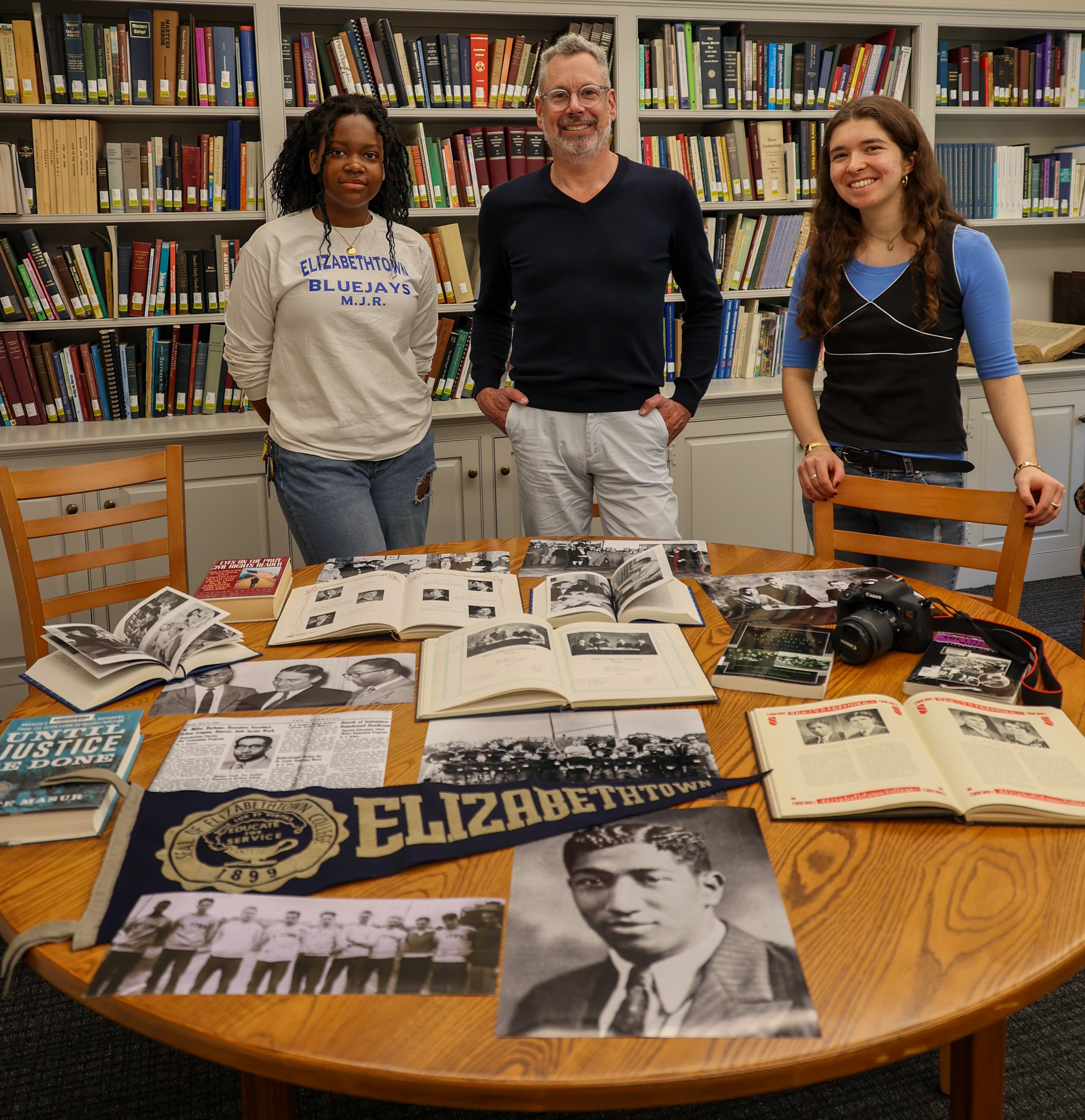
The discovery began quietly with a librarian pausing upon an old photograph he’d looked upon dozens of times before. Now-retired Elizabethtown College archivist Peter DePuydt paused over a 1928 football team portrait displayed in the campus’ Jay’s Nest. He had likely glanced at the image time after time and only then had he noticed, standing in uniform beside his teammates, was a single Black student. The image raised a question DePuydt couldn’t shake: Who was he, and why had his story been forgotten?
That moment of curiosity would become the unlikely spark for a yearslong investigation. The search eventually culminated in the full-length documentary “‘The Prospect for Freedom:’ W. Miller Barbour’s Human Rights Journey,” a film that restores the life of William (Wilbur) Miller Barbour, a civil rights pioneer lost to time and the historical record.
“He was the second African American to graduate from Elizabethtown College,” said Professor Jean-Paul Benowitz, who ultimately became the guiding force behind the project. “He was also the first college athlete in Lancaster County of color to play collegiate athletics.” The college had a football program for only one semester and they lost every single game leading to its disbandment. Barbour’s short-lived Football experience, however, was only the beginning of a life defined by leadership.
Barbour graduated in 1932, guided by the mentorship of Rev. Dr. Ralph W. Schlosser and athletic director Ira Herr who taught him Anabaptist principles of social justice and peacemaking. He went on to earn an advanced degree in social work from the University of Pennsylvania and built a career focused on racial economic justice years before such language became common. “This story is really about the Civil Rights Movement before it got started, and we’re telling it in first person using his words so he could tell his story that was never told,” Benowitz said. In Philadelphia, Barbour addressed juvenile delinquency among Black youth arriving from the South during the Great Migration.
His success there propelled him westward. “He was named the director of the National Urban League in Denver,” Benowitz said. In Colorado and later Los Angeles, Barbour identified what he believed were the two central barriers to racial equality–employment discrimination and housing discrimination. These ideas would later form the backbone of the national civil rights agenda in the 1950s and 1960s, culminating in the March on Washington and the Great Society. Yet Barbour died in 1957, before the movement he helped to conceptualize fully emerged.
To establish the factual foundation of Barbour’s life, Benowitz turned to genealogist Eric Schubert, Class of 2023, who alongside Abigail Sholes, class of 2023, became co-authors on the project. Schubert described the constant evolution of the work: “Even when we thought we were done, more stuff would come up… I think we still have questions.” His genealogical approach involved tracking down scattered, often contradictory documents. “It’s knowing the types of records to look for and then where to find them,” he said. Many official records listed conflicting ages, names, or details.
One of the documentary’s most emotional outcomes came not from archives, but from Barbour’s family. “The family didn’t know anything about him,” Benowitz said. Barbour’s early death, combined with his wife’s unfortunate stroke, meant no stories were passed down. Descendants who tried to research him spent years searching under the wrong name. A turning point came when the Pennsylvania Cable Network broadcast about the project, and one granddaughter discovered it by chance while channel surfing.
Relatives soon contacted the co-authors and shared interviews for the documentary. Their reactions surprised the film team. Many work in fields tied to education, human rights or social justice, unknowingly continuing Barbour’s legacy. As Benowitz put it, “They’ve all been committed to social justice, civil rights, human rights and they didn’t realize what they were doing was building on his legacy.”
Creating the documentary required resourcefulness. No known film footage of Barbour has been found, and only a handful of photographs remain. “Barbour died very young, and even during his life, there really aren’t that many photographs of him. There aren’t that many videos of him,” said Ava Skye Barton, Class of 2027, a Stamps Scholar, Fulbright Scholar and one of the core student filmmakers. She completed the first major editing pass and helped Benowitz write the paper, alongside Schubert & Sholes, that serves as the documentary’s foundation.
Barton interviewed five people in just three weeks, reaching out, traveling, setting up equipment and interviewing them. She described how the film pushed her creatively and professionally. “I hadn’t worked on a project of this size before. I learned a lot about working on a team and being tied to your deadline.” For Barton, telling Barbour’s story held deep meaning. “Being able to tell the story of someone who has not had a lot of awareness spread about his story. I think that’s important,” she said.
Because traditional narration felt too distant, Benowitz chose a first-person narrative, using Barbour’s own words performed by Jake Woodworth, Class of 2026. “I reached out to Jake, of course, he exceeded expectations because he reads the narration with a sense of understanding,” Benowitz said. “The voice really becomes Barbour’s voice. He brings this intimacy to it.”
Woodworth called the experience challenging. To prepare, he studied speech patterns from the 1930s to 1950s. “I tried to put myself into his shoes… having a little bit of empathy towards what he’s going through.” Acknowledging he could not fully know Barbour’s lived experience, he added, “I can’t personally understand [what he’s gone through], but I could try my best and I know what’s gone on historically.” Benowitz praised Woodworth’s clarity: “[There’s a lot of] very long and complicated quotes from Barbour. He breaks it down in such a way that the person who’s following along can understand. It’s almost like teaching.”
The film’s logistical backbone was strengthened by Mechelle Johnson-Reeves, Class of 2028. “Seeing the Civil Rights Movement from the lens before the 60s was really eye-opening,” Johnson-Reeves said. One of her key additions was to help to develop the documentary’s outreach strategy. She helped design much of the promotional material like the film’s posters. Johnson-Reeves identified educators as key partners for film screenings. “Barbour was educating people, so I looked for educators and invited educators who had impacts in their own communities.”
Technical refinement came from Luke Mackey, undergraduate class of 2017, graduate class of 2018, and assistant director of the Honors Program. “Luke polished this thing and really put on the final touches.” Benowitz said. Mackey noted the unusual constraints shaped the film’s creativity. “It’s interesting because we don’t have any video footage of Barbour, just a few photographs,” he said. As Benowitz said, “Miraculously, we were able to find enough images to tell the story.”
The fact that his life might have remained unknown still astonishes the documentary team. “If [DePuydt] never paid attention to that photograph and that one student in it nobody would have ever known he graduated from here,” Benowitz said.
From the moment DePuydt paused over the 1928 photograph, a forgotten history began reemerging. Barbour’s life, his activism, and his legacy now stand restored, not only for his family, but for the broader narrative of American civil rights. Through this documentary, a man whose vision shaped the movement years before its rise finally speaks.