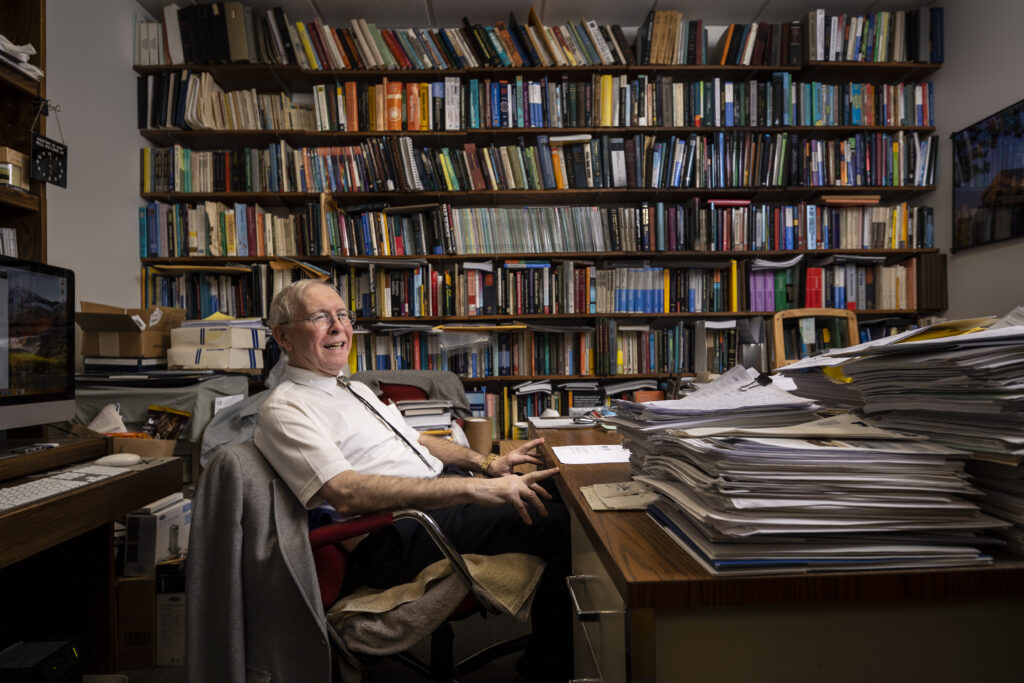
Elizabethtown College’s A.C. Baugher Professor of Chemistry Emeritus Dr. Charles D. Schaeffer, Jr. passed away on March 21 following a short battle with mesothelioma, leaving behind a legacy deeply woven into Etown’s chemistry department.
Schaeffer was born in 1948, in Allentown, Pennsylvania, to Dr. Charles D. Schaeffer, Sr. and Sallie Ann (Koch) Schaeffer. The Schaeffer family was heavily involved with the Allentown Hospital where Charles Schaeffer, Sr. and his father Dr. Robert L. Schaeffer were both surgeons and served as chief surgeon and chief of staff, respectively.
In 1970, Schaeffer graduated with his bachelor’s degree in chemistry from Franklin & Marshall College. He earned his doctorate from SUNY, Albany in 1974 and spent the next two years as a postdoctoral fellow at Yale University.
He joined the Etown faculty in 1976 as an assistant professor and was promoted to A.C. Baugher Professor of Chemistry in 1991. From 1989 to 1993 he chaired the chemistry department. Schaeffer retired, receiving emeritus status in 2009.
“He was very interactive with the students, right up until this year,” Dr. Jeffrey Rood, Schaeffer’s successor as chair of the chemistry department, said. “Most importantly with him he made an effort to get to know all the students around this building [Musser Hall] every year.”
Dr. James MacKay, the current A.C. Baugher Professor of Chemistry, first met Schaeffer in 2007 when he interviewed for a position at Etown and Schaeffer treated him to breakfast.
“He was an intense person, and I think he scared a lot of people because of his intensity,” MacKay said. “Deep down inside he was doing it because he wanted the students to be at their best.”
For his honors chemistry students, Schaeffer would pay to have their theses made into bound books. He would have two copies made, one for his student and one for the chemistry library in Musser. Originally, he had three copies produced before the High Library began declining his donations.
Schaeffer specialized in the field of nuclear magnetic resonance (NMR). He co-authored a textbook on the subject with Dr. Claude Yoder, his former mentor at Franklin & Marshall. Schaeffer was also pivotal in the creation and maintenance of Musser’s NMR lab. He aided MacKay in writing the original grant in 2010 for the lab and has endowed funds to maintain the equipment for the foreseeable future.
“Our department really prides itself on undergraduate research and I think he was probably the one that I could point a finger to in terms of starting that,” Rood said. “Back when he began his career, working closely with students on true novel research wasn’t always the norm and he brought that to the forefront here.”
Schaeffer’s generous philanthropy has funded scholarships and various improvements to buildings and equipment in Musser and on the wider campus including the Bowers Center. More recently he donated funding for the renovation of the first floor in Musser. This summer, the second floor will be renovated thanks to his giving.
“Those are some big picture things, but I think equally important are the smaller things that people may not realize,” Rood said. “He would bring snacks and food weekly for all the students to have in our conference room. He would do these small, behind the scenes things we’ll notice now that he’s gone.”
Throughout his life, Schaeffer became very well-travelled, visiting Europe, Japan, Africa, Australia and New Zealand. He was an avid photographer on his trips and presented some of his work in slideshows on campus. In 1980, he attended a five-day seminar in China where he was the only representative of an undergraduate only institution.
“Fish-out-of-water isn’t quite the right word,” MacKay said. “But he was a unique individual at some of those conferences because he was coming from a small school like Etown and interacting with people from these prestigious research institutions from all over the world.”
For his colleagues, Dr. Schaeffer’s contributions to Etown’s chemistry department for almost fifty years have created the department as it stands today.
“His legacy is the foundation for the way our department functions on a small personal touch level,” Rood said. “He was very foundational in setting this small community, getting to know the students, support them however you can, and learn about their goals.”