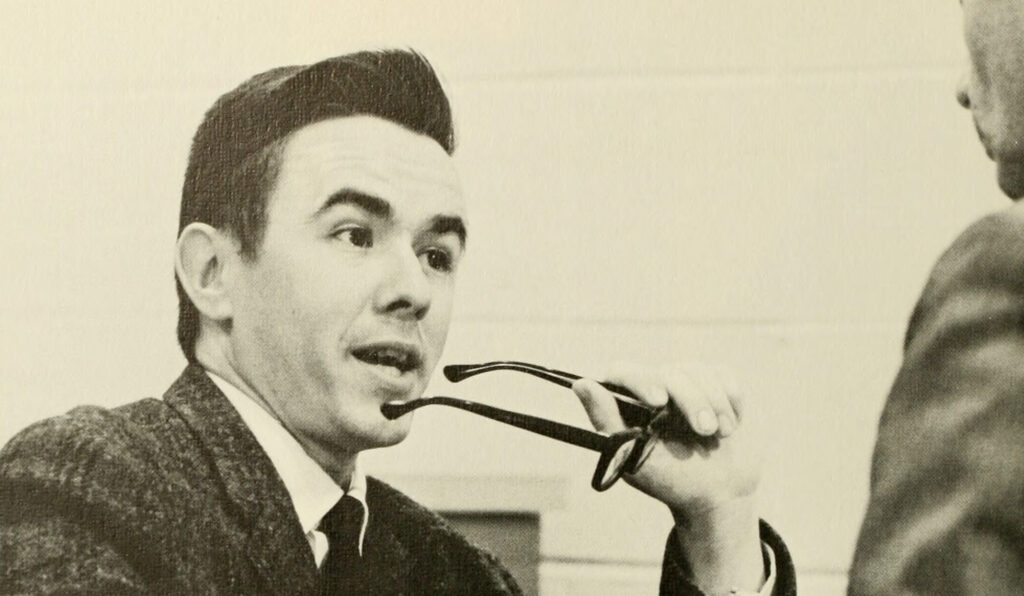
Dr. J. Kenneth Kreider, professor emeritus of history, passed away at the age of 91 on Oct. 19 following a recent diagnosis of an aggressive form of cancer.
A lifelong resident of Lancaster County, Kreider was born on April 7, 1934, to A. Clyde and Catherine Herr Neff Kreider.
After graduating from Southern Lancaster County Joint High School, Kreider registered as a conscientious objector, refusing to sign up for the military draft on religious grounds.
As a conscientious objector, Kreider was instead to provide alternative service that met the national interest of the United States.
He joined the Brethren Volunteer Service in 1954 and was first assigned to the National Institutes of Health in Bethesda, Maryland. as a human test subject for medical research. He was later transferred to the University of Michigan Hospital in Ann Arbor where he underwent intense metabolic experiments.
When his time as a test subject ended, Kreider was assigned to work with the Heifer Project in West Germany, giving calf-bearing cows to refugee families who had fled Soviet occupation in the east after the Nazis’ defeat.
In 1956, Kreider was transferred to Austria where he worked in a refugee camp, housing those who had fled the Soviet crackdown in Hungary after a failed revolution against the Soviet-aligned communist government.
Kreider’s final assignment abroad saw him settling war refugees on the Italian island of Sardinia—a project where he partnered with actor Don Murray.
A witness to the destruction caused by World War II, Kreider decided after his service ended in 1957 that he would go to college.
“I wrote home to my mother and said, ‘I’ve decided to go to college for a year. I want to find out what caused World War II,’” Kreider recalled in 2024. “She wrote back and said, ‘We’d be proud to have a college graduate in the family.’ I thought, ‘Who said anything about graduating?’”
Kreider would end up studying at Elizabethtown College for more than a year, earning his bachelor’s degree in history in 1961.
At college, Kreider also met his future wife, Carroll Hall. The couple were married in 1959.
Earning his master’s and doctoral degrees at Penn State University came next for Kreider before ultimately returning to Elizabethtown as a history professor in 1964. He retired in 1999 but continued to be involved with the college.
“This is my thirty-second year teaching at Elizabethtown College, and when I first arrived, Ken Kreider was the chair of the history department,” Professor Jean-Paul Benowitz said. “He was an extraordinary historian, a wonderful colleague and a very good mentor.”
Kreider was also an activist against the Vietnam War, speaking out against the United States’ war policy, organizing protests on campus and leading protest groups to Washington, D.C.
His opposition to the foreign conflict stemmed from his devout faith as a pacifist and membership with the Church of the Brethren. He opposed the Iraq War on similar grounds.
“The government says to have peace you must kill and destroy,” Kreider told congregants at the First Church of the Brethren in 1966. “This is contrary to God’s law which says ‘Thou shalt not kill.’”
Kreider also found a way to share his thoughts on current events with a wider audience through “Letters to Editor” published in Lancaster County’s LNP.
He was also a published author outside of the newspaper including his book A Cup of Cold Water: The Story of Brethren Service and his autobiography From the Buck to E-town: An Awesome Journey. A short story of his was also published in Chicken Soup for Grandma’s Soul.
Annually since 2015, the Kreider Prize for Teaching Excellence has been awarded to an Elizabethtown faculty member. The prize is named for Kreider and his wife and is endowed by a former student of his.
“Dr. Kreider was respected by students and colleagues because of his academic rigor as he challenged and mentored students to exceed expectations,” Benowitz said. “An extraordinary historian and scholar, Dr. Kreider motivated students to pay attention to the people and places all around them while seeking opportunities for service and peacemaking which he exemplified.”