
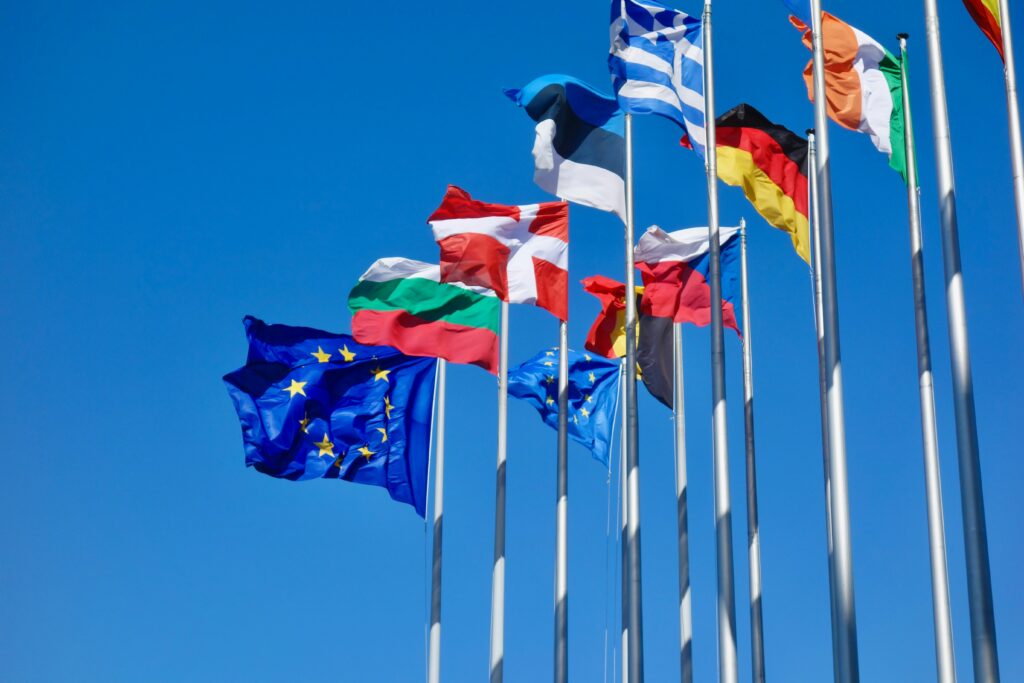
For the past few months, members of the European Union (EU) have had their airspace violated over and over by unidentified drones (NYTimes). This has resulted in increased tensions and a further deterioration of relations between the EU members and Russia, the prime suspect. The Kremlin has both denied these claims and claimed they were merely a training exercise and nothing to be concerned with. However, the consistency of their presence and the threat they pose has not ceased.
Most recently, according to Politico, this weekend unidentified drones had caused major chaos in the country of Belgium. The two largest airports and cargo airports were forced to shut down during the incursion, forcing planes to land and disrupting scheduled flights.
Along with this, multiple military facilities and economic installations such as Euroclear were targeted by these drone flights, as reported by CBS News. The importance of Euroclear being a target is made clear due to its position of holding the majority of Russian financial assets that are currently frozen by Belgium and the EU. Some members wish to use these assets to fund Ukraine’s fight against the invader, however for the most part Belgium has been reluctant to do so.
There is also a significance targeting Belgium, as it not only holds the headquarters for the North Atlantic Treaty Organization, the alliance specifically formed to counter Russian influence, but also the headquarters for the EU itself.
Belgium has taken steps to counter these incursions into their airspace by building up their air defenses and calling on its allies to help in the meantime. According to Politico, the Belgian National Air Security Center will not be completed till Jan. 1, forcing the country to turn to the United Kingdom, France and Germany, its largest neighbors, for assistance. These countries were quick to lend both resources and personnel to help the Belgians form a powerful resistance against any potential invader.
Belgium has also begun to consider calling on Article 4 with NATO, bringing other members of NATO into consultation with Belgium on how to move forward with this issue, as stated by The Insider. Article 4 has been invoked sparingly in the alliance’s history, however just this year it was called twice when Polish and Estonian airspace were also under threat due to incursions. This article does not require military action like Article 5 does, but if the meeting would lead towards that direction, relations could become even more constrained between NATO and Russia.
There are a few members of the alliance who are taking a stronger stance against Russia in these airspace raids. According to CBS News, countries like the Baltic states, Estonia, Latvia and Lithuania, have directly stated that these drone sightings are the result of Russia or a collaborator, with Russia and Belarus being the prime countries accused. The more powerful members seem to be more hesitant to outwardly blame Russia formerly as the antagonist continuously shows its ability to reach even the furthest country in the union.
This does not stop authorities in these countries from casting their blame, such as Germany’s Defense Minister Boris Pistorius who according to Politico stated that “the drone incursions are linked to the ongoing talks on using Russian frozen assets to help fund Ukraine’s effort to defend itself against Moscow’s all-out invasion.” Once again, this is directly connecting the drone strikes to the frozen assets, marking them as a threat against using them to fund Ukraine.
As the war in Eastern Europe continues to rage with no end in sight, the EU and NATO seem to be vigilant to contain it to just the two countries, wanting to not expand it to the whole of Europe. However, with the increasing incursions of these drones, tensions are only due to rise.