
Each December, faculty members at Elizabethtown College nominate peers for the Ranck Award of Research Excellence. This award was established in honor of John P. Ranck, former chair of the Department of Chemistry and Biochemistry. The award recognizes a full-time faculty member for their achievements in research and commitment to their field.
The 2025-26 awardee was Dr. Kirsten Johnson, a professor of communications.
“It’s nice to be recognized by your peers for work that you’ve done,” Johnson said. “I’ve been really thankful to the committee for selecting me, and really thankful to my Dean, April Kelly, who nominated me for the award.”
Johnson’s career in the communications field evolved from her participation at the radio station at Drake University. Johnson said she was drawn to a career in broadcast journalism due to the ability to choose stories to produce and share with thousands of viewers.
“I was really drawn to [the idea] that I could shape what people were seeing and then what people were thinking about it. I don’t think people think about how powerful communications can be and how we encounter communications every single day in our lives,” Johnson said.
Johnson interned at WOI-TV, the ABC affiliate in Des Moines, Iowa. While still studying full time, Johnson took on a position as TV News Producer full time during her senior year at Drake University.
“That entailed me going in at 2 a.m. and putting together a rundown and writing stories for my anchor,” Johnson said. “I worked until right around 11 a.m. then I would drive back to campus … and then I would take classes in the afternoon, and I would go to bed early, because I had to get up at 2 a.m. and I would do it all over again the next day.”
After moving to Pennsylvania, Johnson worked as a news producer for the local NBC affiliate, WGAL-TV.
Johnson strived to teach and pursued a masters degree in telecommunications at Kutztown University and a doctoral degree in science and technology at Drexel University. After receiving her masters degree, Johnson began teaching communications at Etown.
“The job at E-town came open just as I was finishing up my master’s degree, and they hired me here. The timing was perfect,” said Johnson.
Research in the communications field became another large dedication of Johnson’s. She has numerous publications, including books, book chapters and peer reviewed articles.
Johnson’s research is heavily focused on the lowering rates of trust and credibility within the media.
“Over the years, what we’ve seen is that there’s been an erosion of trust, steadily, and now we’re seeing a big drop off in terms of the number of people who trust news and the news media,” she said.
Johnson states that this research is important for journalists, as it explores how they can get people to trust the information being delivered to them. She explains that there are markers of credibility that can be put in a story to make information appear to be more trustworthy to the public.
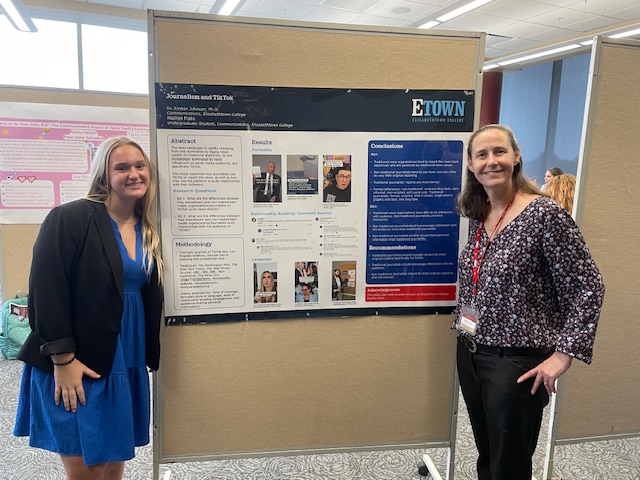
Senior Madilyn Fratis, a communications major, has worked directly with Johnson on research as well as presenting alongside her at the Pennsylvania Communication Association Conference. A topic of research explored was citizen journalism, which is becoming more frequent with younger generations on social media.
“Dr. Johnson and I have been exploring what citizen journalists look like. What are the pros and cons of each type of news outlet, and how can traditional news outlets cater their content towards an audience on social media? How can those social media creators create more credible and reliable content so everyone can be informed,” Fratis said.
Fratis said that Johnson’s achievement of the Ranck Award was well deserved.
“Her ideas are very relevant and are really tackling big topics that there’s not a lot of research in yet about social media and journalism and how the field is constantly changing,” she said.
“Personalized News Communication and Media Trust in the Modern Era,” Johnson’s latest publication, features interviews with journalists across the country. The book discusses what journalists are doing in newsrooms to create trust with audiences.
“Journalists are really doing some amazing things in their newsrooms that we don’t even realize, in terms of trying to build this credibility and trust and trying to build community with their audience members,” Johnson said.
Johnson plans on shifting her upcoming research to explore how the use of artificial intelligence could affect readers’ trust in news outlets.
“I want to look at if a news organization discloses that they’re using AI, how does that impact people’s thoughts about credibility and trust towards not only the story they’re reading, but also the organization itself?” Johnson said.
Johnson’s advice to students is to become involved on campus and do internships. She says these opportunities will help students explore different paths, build new skills and help land potential jobs in the future.