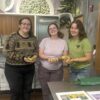
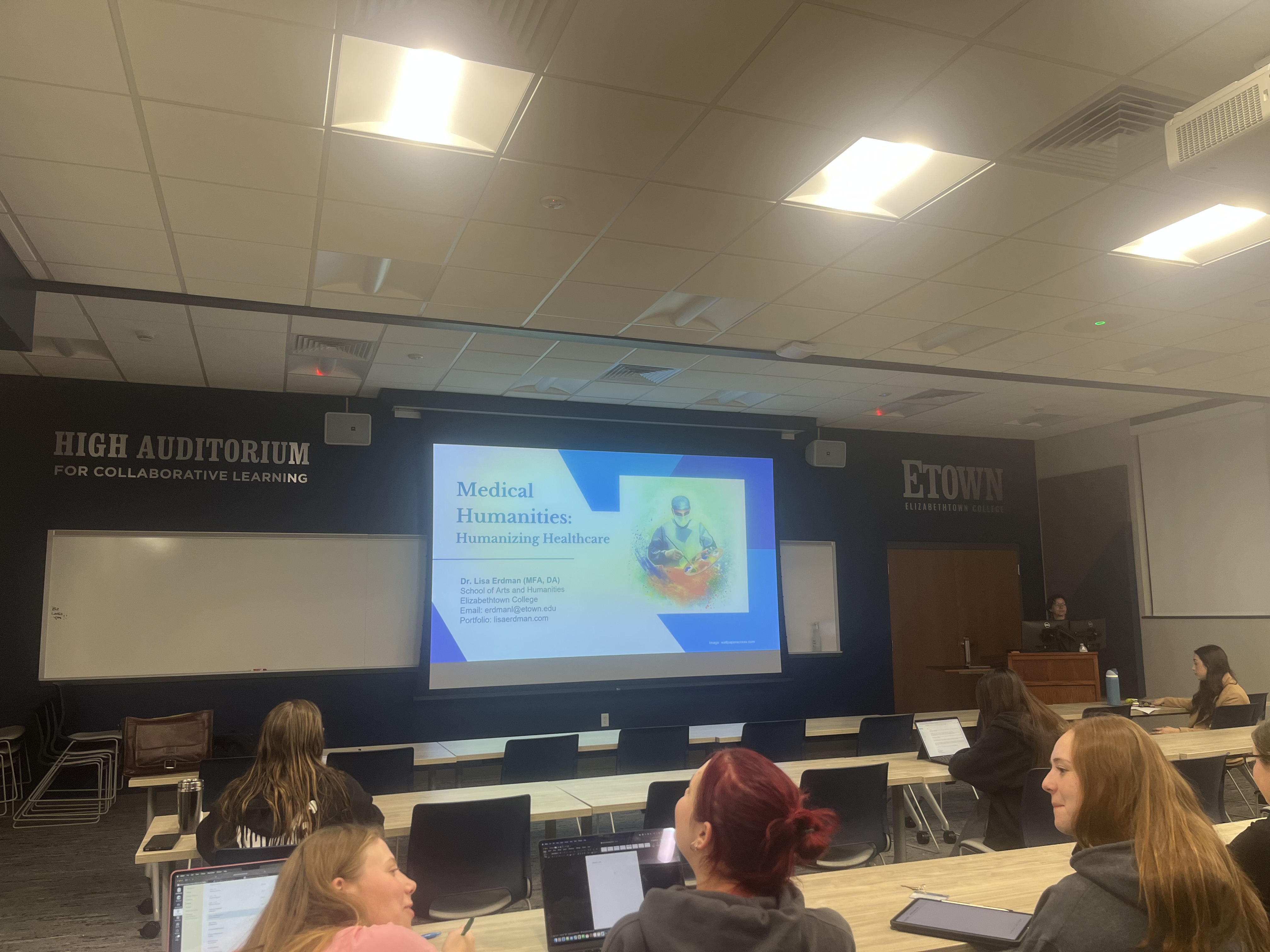
Recently, Elizabethtown College hosted a Medical Humanities talk hosted by the School of Arts and Humanities. This growing field is starting to build a stronger home for itself at Etown with the growing medical humanities minor the college offers. This event offered an overview of what the medical humanities are, along with details of what type of courses the minor has to offer.
Dr. Lisa Erdman took the lead of this event, offering a detailed and enriching speech discussing the importance of this field. Prior to her time at Etown, Erdman worked at Pennsylvania State University in the College of Medicine. During her time there, she taught classes where she introduced the idea of fostering environments between doctors and patients.
This field encourages relationship building and patient recognition. During the presentation, Erdman talked about different methods that people can interact with that connect with medicine on a deeper level. Erdman showed the audience a painting by Frida Kahlo titled “The Broken Column” which served as an example of medical humanity artwork. This 1944 oil paint on masonite painting showed Kahlo’s personal injury. Erdman uses artwork like this to teach people how medicine and health has a deeper impact than some may realize.
Professors and educators can use artwork like this to teach medical students about body language, facial expressions and pattern recognition. Erdman recognizes how important these topics are inside the medical field as a doctor must be observant.
English literature professor Patrick Allen said that he is also involved with this field, taking a larger focus on it in his graduate career.
“Training in the medical humanities can be beneficial to students in all fields, whether they plan a career in medicine or not,” Allen said. “The level of detailed analysis Dr. Erdman demonstrated is a valuable skill in teaching, law, business, and other fields, so I’m glad the presentation showed the field’s versatility and use.”
In this field, people are encouraged to interact with artwork, poetry, prose, music and other creative expression forms. Erdman says that the “awareness of the person’s story” is a priority in this field as it encourages open communication between healthcare workers and patients.
The presentation itself also discussed the history of this field, where it was stated that the idea of medical humanities goes back hundreds of years and has been recognized in medical health books since the 1960s, but today it is more commonly required in healthcare profession majors. Major themes of the medical humanities include clinical ethics, health equity, disability, racism, sexism and more.
Etown offers a medical humanities minor with a wide variety of classes to take with it. One example is Dr. Patrick Allen’s Graphic Medicine class. This course teaches elements of the medical humanities through a literary lens, focusing specifically on comics and graphics. In this course students read medical graphics and make their own comics.
Another course for this minor is Dr. Lisa Erdman’s Introduction to Graphic Medicine course, where they cover all different types of creative medical based works like artwork, literature and more. Students learn about ethics, morals and the arts in medicine while also creating their own expressive pieces.
Erdman is passionate about patients advocating for themselves. “Their story counts. Their story matters,” he said.
The medical humanities field has an extreme amount of education to offer students who pursue this minor. “There’s so much to be gained from reading texts through a medical humanities lens. We can learn about how people survive medical traumas and perhaps even prepare ourselves for such experiences by reading the stories others have to offer,” Allen said.
It is clear that this field is expansive and has so much to offer. Etown has an enriching and educational medical humanities minor of which students should be aware.