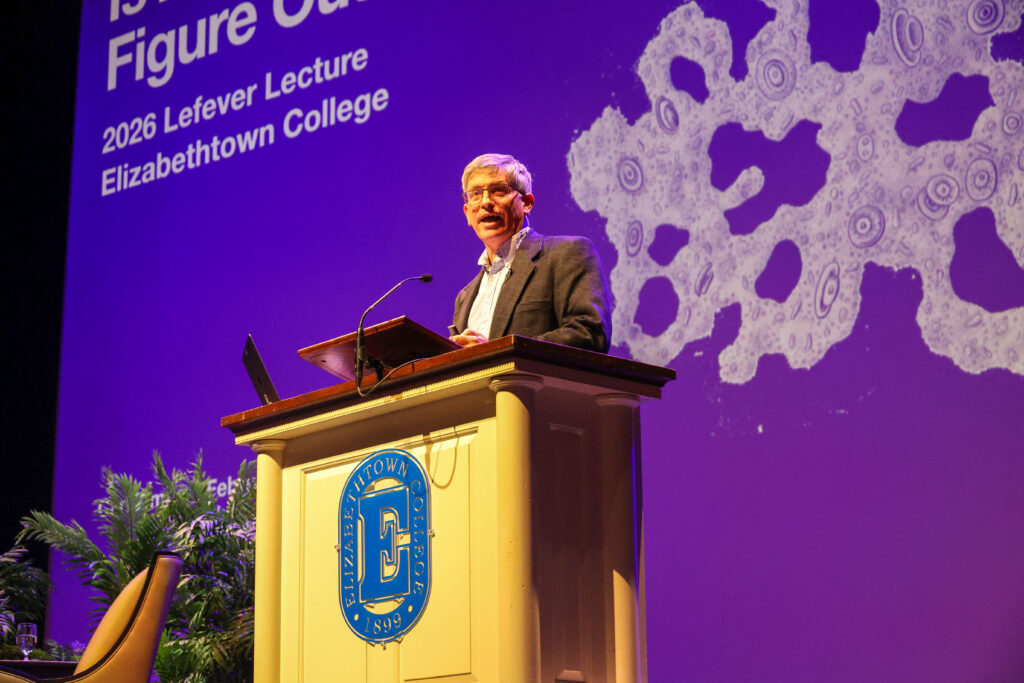
Science journalist and author Carl Zimmer invited students to think differently about life, technology and the future of biology during the Leffler Lecture Series on Feb. 12 in Leffler Chapel.
Zimmer, a New York Times columnist and author of several science books, opened his talk with a simple question. He had asked ChatGPT, “What is life?” The response was detailed, but also unclear. For Zimmer, that answer showed how complicated the question really is. Scientists have debated what defines life for centuries, and new technology is forcing them to rethink those ideas again.
Much of Zimmer’s talk drew from his book “Life’s Edge,” which explores how scientists have tried to define life and how those definitions continue to change. He walked the audience through moments in history when people misunderstood what life was, including early theories that ocean slime held the key to life itself. Over time, scientists came to focus on cells and DNA. Now, Zimmer said, artificial intelligence is pushing those definitions in new directions.
Zimmer explained that modern AI systems work by recognizing patterns in massive amounts of data. Unlike traditional programs, they are not told what the correct answers are. Instead, they adjust their predictions based on feedback. This method, he said, is loosely inspired by how the human brain learns. In biology, that approach is already making a difference.
One example Zimmer shared was AlphaFold, an AI system developed by DeepMind that can predict how proteins fold into three-dimensional shapes. Those shapes are key to understanding how proteins work in the body. For years, scientists struggled to solve these structures through experiments alone. AI has now made that process much faster.
At the same time, Zimmer urged students not to overestimate what AI can do. He reminded the audience that AI does not actually understand biology. It produces useful results without knowing why those results are correct. He encouraged students to stay curious but also cautious when hearing bold claims about what AI might achieve.
First-year student Emma Lohss said the lecture helped her see AI in a new light.“I had heard almost nothing about AI in biology or medicine,” Lohss, an environmental and political science major, said. “Most of what I hear about AI is that we should not use it for assignments. I did not realize it could actually be helpful. It changed how I think about what AI can be used for.”
Another first-year student, Lauren Vaughan, said the talk helped connect what she learned in class to real-world science.“I knew a little bit about proteins from biology class, but hearing how AI is used to predict their structures made it easier to understand,” Vaughan, a political science and legal studies major, said. “It was interesting to see how technology is helping scientists solve problems that used to take years.”
Zimmer also touched on concerns surrounding AI, including the possibility of misuse and the environmental impact of training large computer models. He explained that running powerful AI systems requires significant energy and water, which raises questions about sustainability. He encouraged students to think critically about both the benefits and the costs of new technology.
During the question and answer session, Zimmer addressed whether AI might replace jobs in science and medicine. He said technology itself does not replace people. Employers and institutions make those choices. AI, he added, should be seen as a tool that can support research rather than replace human judgment.
Zimmer also spoke briefly about writing in the age of AI. He warned students against using AI to generate essays, saying it prevents people from developing their own thinking and voice. He described AI writing as generic and argued that learning happens through the effort of forming ideas.
The lecture ended on a lighter note when the moderator asked about love and attraction. Zimmer, who has written about how particles and scents move through the air, joked about pheromones and reminded the audience to be skeptical of products claiming to bottle attraction.
For Lohss, the event showed the value of attending lectures outside her major.“I am not a science person,” she said. “But hearing this talk helped me understand more about how science connects to everyday life. I am glad I came.”