
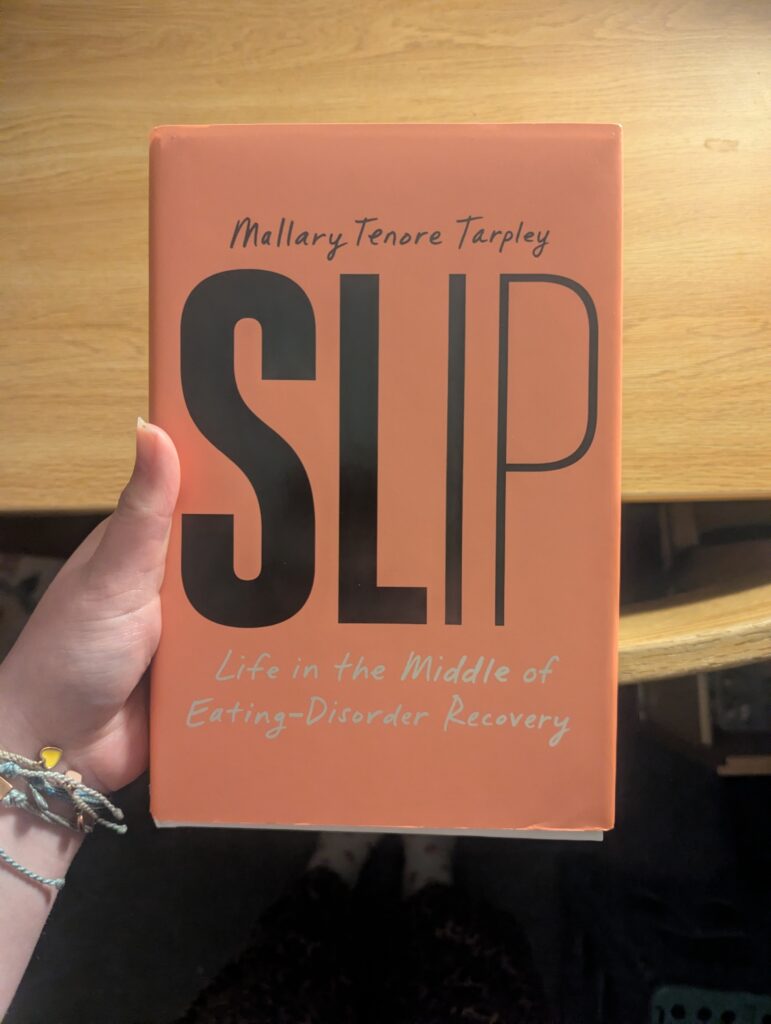
Students filled the High Auditorium in the Steinman Center on Feb. 9 to hear author and journalist Mallary Tarpley deliver a brief reading, followed by a guided discussion and an audience question and answer session.
Tarpley’s journalism career includes work with major news outlets such as The Washington Post, Los Angeles Times and The Dallas Morning News. She has also held roles at the University of Texas at Austin and co-organized initiatives that support journalists.
Tarpley’s latest book, Slip, published on Aug. 5, 2025, is a memoir that blends her personal narrative with reporting to examine eating disorders and the grey space in recovery.
The book features 724 people surveyed as well as 175 interviews to further deepen the idea of the “middle place.” The “middle place” was what Tarpley called the uncomfortable and often stigmatized space between being visibly ill and being fully recovered.
Tarpley described the process of recovery as not a simple and clean breakthrough, but as movement forward through slips. She describes how setbacks are possible and expected, but they are not permanent.
The title of the book, Slip, represents that idea. The quiet and sometimes secretive ways that disordered eating can return and how it takes courage to acknowledge and grow from those moments rather than hide them in silence.
“I think her experience and message about how it’s okay to be stagnant and in the middle of recovering fully and very ill was important because in all aspects of life we are in the middle of being fully bad and fully okay,” Olivia Goldman-Smith, a first year early childhood education major, said.
In both Tarpley’s reading and discussion, she challenged what she described as normal eating disorder narratives that are often black and white and narrowly defined. She addresses how perfectionistic ideals, especially for young girls, can fuel harmful cycles of self-worth tied to body image.
She briefly spoke about growing up feeling pressure to be “perfect,” describing how perfectionism can become an illusion, something that is impossible to fully achieve, but powerful enough to take control of one’s life.
Tarpley also discussed how her mother’s battle with cancer and eventual passing shaped her relationship with control, worth and attention. She reflected on how, especially as a child, staying sick felt like a way to stay connected to her mother. This is a dynamic she later had to unpack and reflect on during her journey to recovery.
Unlike many memoirs, Slip does not rely solely on Tarpley’s own personal narrative. As an experienced journalist, Tarpley incorporated intensive research and interviews within her book. This added hundreds of stories of other individuals with lived experience.
She described the book as a “memoir plus” combining both her reporting and personal narrative to better understand how eating disorders affect individuals and families across the world and many different backgrounds.
A point Tarpley made during the question and answer session was how early messages can shape children and their habits. She expressed the importance of language, avoiding the use of “good” and “bad” as labels for foods and instead showing her own children to respect and appreciate their bodies.
Categorizing foods and moralizing eating habits can contribute to the black and white thinking which can later fuel disordered behaviors.
Authentically embracing the “middle place,” even considering it as a space between warning signs and acute illness as well as the space between illness and recovery, can help people develop better understandings of our imperfections.
The audience included students and community members: some with lived experience, students studying mental health, aspiring journalists and those interested in how to better understand eating disorders. Some attendees shared their own struggles as well as loved ones’ struggles, asking many questions on how to reach out for help or how to help those who may be silently struggling.
By the end of the evening, the message was clear: recovery is messy, nonlinear and deeply human. Naming these complexities, rather than hiding, is a part of the healing process.
“I hope that this event sparks discussion among students and shows it’s okay to ask for help, it’s okay to struggle, it’s okay to feel stuck, and more so, it’s okay to tell someone that,” Goldman-Smith said.
As students filtered out of the auditorium, many bought copies of Slip to be signed. Students also left with a reframing of what it means to struggle, slipping but moving forward anyways.