
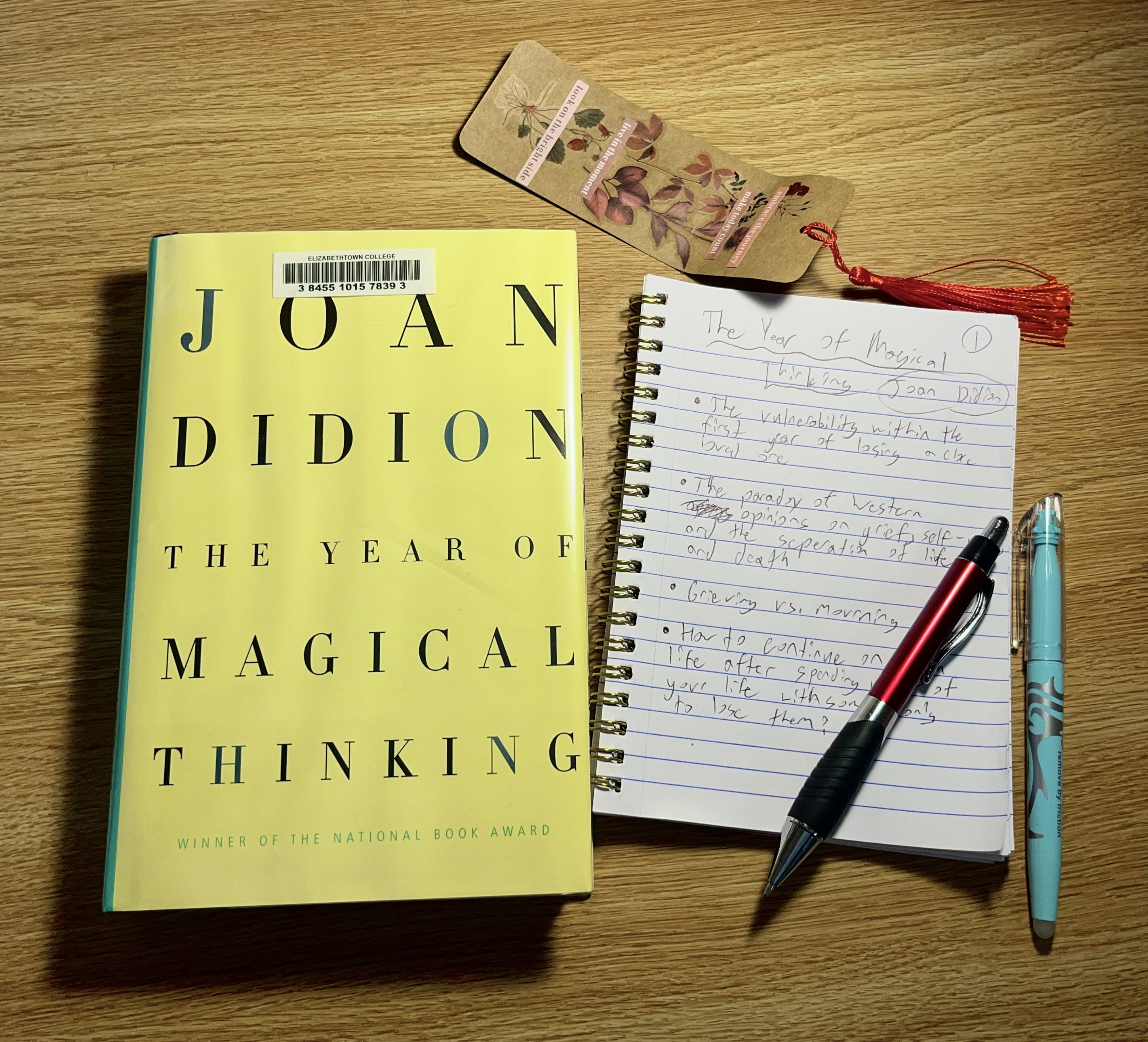
I’ve always been an avid reader, eager to devour, analyze and apply the lessons from literature to everyday life. My personal library contains plenty of well-loved fiction novels, such as The Hunger Games, anything written by Mary Oliver and a couple of classics that were mandatory reading in school that moved me enough to buy my own copy (I cannot recommend 1984 or The Great Gatsby enough!). It’s only now in college that I’m starting my foray into the world of non-fiction, and my only regret is waiting so long to start.
One of the first authors I explored was Joan Didion, a brilliant, authentic and sharp-witted journalist, later an author. Perhaps her most famous work, The Year of Magical Thinking, is a raw and moving memoir about the death of her husband, John Dunne, after nearly 40 years of marriage. The loss strips her of all rational thought and leaves her to navigate life without her other half.
Didion’s grief leads her to engage in what she labels as “magical thinking,” akin to childlike reasoning. She can’t throw away John’s shoes because “he might need them again,” and if she can retrace her steps far back enough, she can create another timeline in which John is still with her. As someone who has lost loved ones, I could only empathize and relate heavily to this line of thinking. When you lose someone, the only thing you want is for them to come back to you.
One phrase from the book truly stuck with me: “Life changes fast. Life changes in the instant. The ordinary instant. You sit down to dinner and life as you know it changes.” That phrase is repeated as often as Didion’s heart beats. It’s a painful irony, considering that her husband passed from cardiac arrest.
What she means by this phrase is that death can strike at any time, even at a time as ordinary and routine as preparing dinner. We imagine death as a big, catastrophic event, but oftentimes, it can be mundane, which can make it that much more devastating. The outward world keeps passing by as yours collapses inwards.
Furthermore, her account of grief is one of the most accurate and authentic portrayals one can find. The unfortunate and inevitable truth of life is that everybody will lose someone they love; grief is the price tag that comes with loving someone. However, the experience doesn’t have to be lonely. Quite the contrary, death can allow you to align yourself with others in literature, music, artwork, film and so on.
I’d recommend this book to anybody who has experienced the loss of a loved one. It is nothing short of healing to see yourself identified so clearly through another’s experience. It is comforting to know that you’re not the only one who feels as if your world is being turned upside down. If how Didion is described intrigues you enough to check out her other works, my first recommendation would be Slouching Towards Bethlehem. The piece is a series of journalistic essays from the 1960s covering disillusionment, personal anecdotes and with an overarching theme of the social threads of society coming unwound.