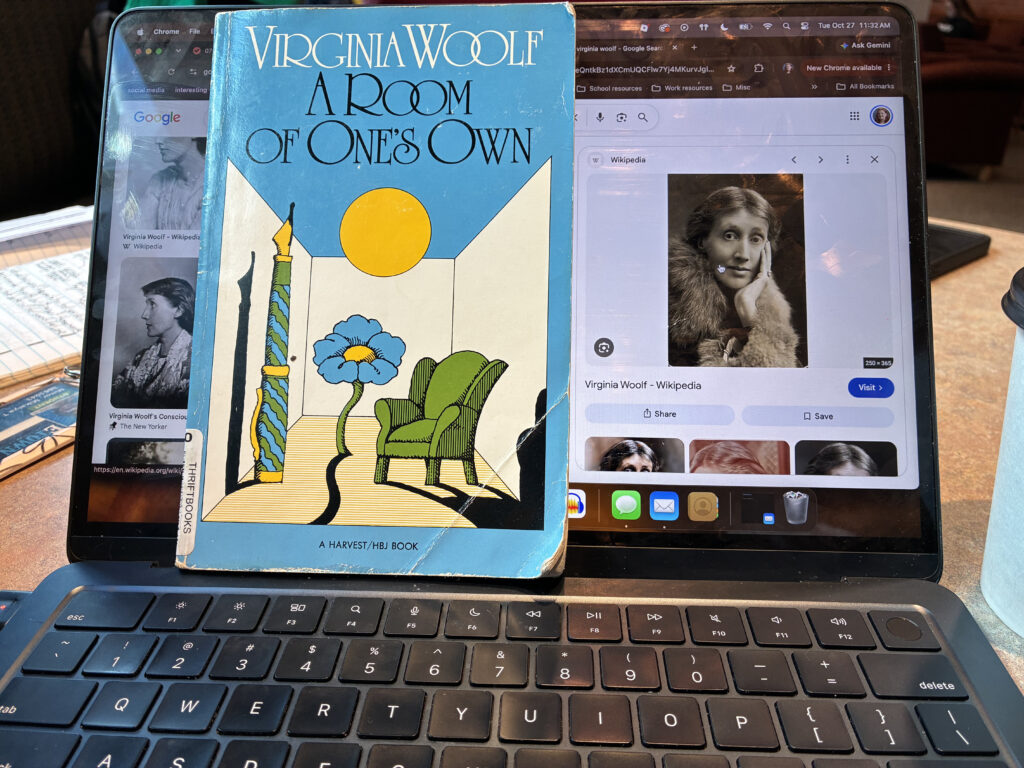
Virginia Woolf’s “A Room of One’s Own” may have been published nearly a century ago, but its argument about women’s place in literature still holds a place in today’s conversations about feminism and equality.
Published in 1929, nearly a century ago, “A Room of One’s Own” remains a foundational feminist work. Virginia Woolf challenged the barriers that prevented women from achieving the same literary recognition as their male counterparts, arguing that the issue was not a lack of talent, but a lack of opportunity.
Woolf further argues writing will remain a masculine pursuit until women have a room of their own and an income to depend on that doesn’t come from a man.
When she says a room of one’s own, she is referring to a physical space that belongs completely to a woman. Not only that, but a room that is quiet, and away from family.
Women and their interests are too often pushed aside in favor of family affairs. A realistic scenario looks like this: a woman would end up writing in a busy parlour room with children tugging on her dress, husbands incessantly asking when dinner is ready and in-laws judging her for writing instead of sewing. Due to this, most women didn’t and still don’t have the same opportunities that men do to make the best of their craft.
The second point Woolf makes is the need for a disposable income that is independent from her husband or father. Disposable income is money that someone can spend after paying for rent, groceries, or amenities.
The best writers incorporate their life experiences into their work. But what life experiences do stuck in the home have to draw from? An income provides women with a window to other lives and out of the house.
Furthermore, we have missed out on countless Shakespeares, Steinbecks and Kafkas, simply based on gender.
I think about that a lot, how many generational voices we may have missed out on due to identity politics. History has a very selective box for who can be an artist. You can either be a white man and an artist or anything else and not an artist. You lose perspectives that could enrich future generations.
While dense at first, I enjoyed reading “A Room of One’s Own.” There is certainly a generational language gap, or in other words, while reading I’d feel like, “Why would you phrase it like that?”
The way Woolf writes reminds me of “Fahrenheit 451” by Ray Bradbury. Both authors write with a lot of detail and the true meaning of sentences takes some detective work to understand. But once you become fluent in an author’s style, it’s a fun puzzle.
However, this is not the kind of book that you can pick up randomly off and on again. It requires concentration and a decent chunk of time.
Although we are far from 1929, many of Woolf’s criticisms of how society treats women writers remain relevant. Things have certainly gotten better but female authors still face many barriers that men don’t. Women are frequently undermined, considered less serious than men, less intelligent, too emotional, etc.
Until women’s literature is given the same consideration as men’s literature, women will still be searching for, as Woolf puts it, a ‘room of their own.’