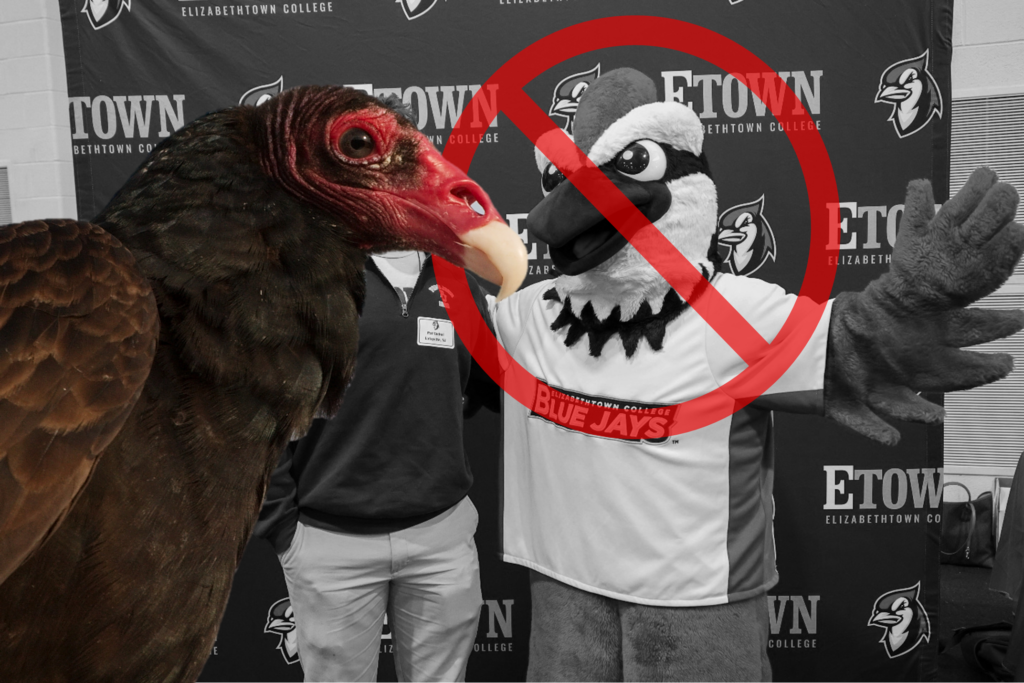
The Blue Jay will no longer be the official mascot of Elizabethtown College following a surprise announcement. The replacement mascot will be the turkey vulture.
This change means the retirement of an 80-year-old mascot deeply tied to the college and its achievements. Prior to the adoption of the Blue Jay, a different mascot represented Elizabethtown, alternatively called the Grey Phantoms or the Galloping Grey Ghosts.
The 1940s saw the blue jay replace the Ghost as the mascot for Etown athletics and the wider college. A vote by the student body in the 1945-1946 academic year sought to find a replacement, settling on the blue jay and officially adopting it the following year. The bird was embraced by then-college Athletic Director Ira R. Herr as a scrappy fighting bird.
It would not be until 1950 when the Blue Jay made its first appearance as drawn by C. Frederick Horbach ’53 who was president of the Student Senate at the time. The bird went well with the college’s already established color scheme of blue, grey and white.
Now the turkey Vulture will raise its six-foot wingspan to represent Etown. A change in the college’s colors is also in order due to the lack of colorful plumage on the carrion-eating scavenger. The raptors are primarily brown to black in color save for the bright red to pink shade of their fleshy bald heads, giving them their name due to their resemblance to turkeys.
“I think it’s unfortunate,” junior student Tommy Kanakos said of the mascot change. Kanakos is a player on the baseball team and will be playing as a Vulture next season. “I think a blue jay is a lot cooler than a turkey vulture, but I think we could get a lot of new uniforms, and it would look pretty cool.”
Much like the blue jay, turkey vultures are a common sight in Pennsylvania, staying year-round throughout the seasons, especially in the southern regions of the state like Lancaster County where more northern populations will occasionally migrate. They frequently populate suburbs and farmland like the area surrounding the campus.
The change was reportedly due to two factors: the bird’s demeanor and the abundance of turkey vultures on campus.
Vultures are a more docile bird than the blue jay and serve a useful ecological purpose as scavengers feasting on carcasses of deceased animals. Although favored by Herr for their scrappiness, blue jays also have a reputation for being mean and territorial—many a bird feeder has been held hostage by a blue jay not in the mood for the sharing of seed.
Turkey vultures are rather tolerant of human activity and lack a syrinx, or vocal organ, meaning that they produce more subdued sounds such as grunts or hisses as opposed to the piercing squawk of a blue jay. Although their morbid eating habits and dark colors give turkey vultures a different popular reputation.
“It kind of sounds more aggressive,” sophomore student Cory Rible, another student athlete said. “[But] I’ve always liked playing as the Blue Jay, especially the colors.”
A flock of about thirty vultures has become a common sight on campus. They are frequently seen circling in the sky or gathering en masse in trees surrounding the Dell. In contrast with blue jays who are a less common sight and never seen in the same numbers as the vultures.
“If we do see them a lot more they might as well be our mascot,” Kanakos said.
Blue the Blue Jay mascot is expected to be retired. There is no word yet as to what the name of his Vulture replacement will be.