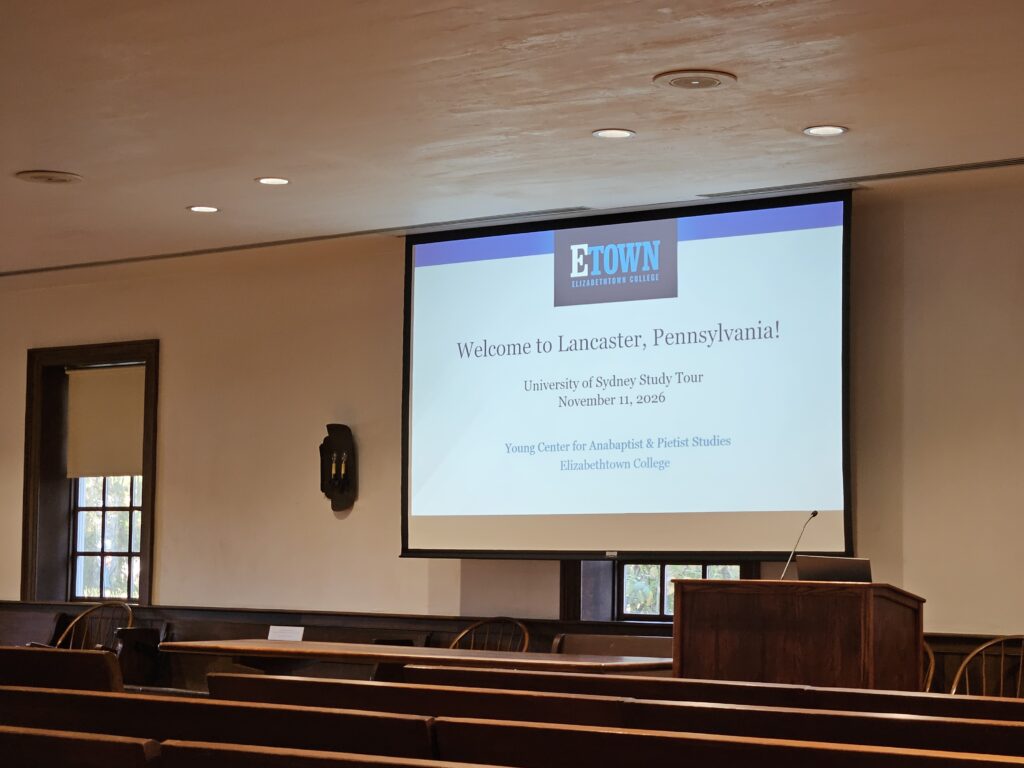
A group of 20 postgrad and undergrad students and two faculty leaders from the University of Sydney in Australia visited Elizabethtown College’s Young Center for Anabaptist and Pietist Studies on Nov. 11. This is the first time they’ve visited Etown. The connection was made through Javita Thompson, Etown’s former senior director for engagement, mission and impact.
The students are from different interdisciplinaries ranging from art to computer science, but all have an interest in American politics. They came to campus to learn about midterm elections and the Amish lifestyle.
Being in America during this time let them see how Americans understand political power and how the ideas are shown through our institutions and communities.
They spent a week in Washington, D.C. and a week in Pennsylvania. While in Washington, they visited the Library of Congress, the Smithsonian, George Washington University and Georgetown University. In the second half of their trip, they went to the University of Pennsylvania, the Pennsylvania State Capitol and finally to Etown. They had a mix of formal academic lessons and conversations with members of our communities.
Finnian, a student on the trip, said he liked the walkability of Washington. He is also originally from California, so he said it felt like “being back home.”
They specifically chose locations that give a variety of perspectives. Being in Washington during election week placed them near the political culture of our capitol. According to Anna, a faculty member on the trip, they visited Pennsylvania because of its political history and how it used to be the first capitol. Being in the state was a great opportunity to look at the Amish and how religion intersects with politics.
Dr. Nathan Gibson, assistant professor of political science, opened their day on campus by explaining the midterms more in depth. He talked about how we switched from a Republican-controlled Congress to a Democratic one, what may or may not change and other topics like divided government. The students were very inquisitive.
After the lecture with Gibson, Director of the Young Center Dr. Steve Nolt taught about not only the local Amish population, but the national one as well. He has had a strong connection with the Young Center since the 1990s, starting with a research project.
One particularly impactful part of the presentation was how he opened it. There were two pictures: one with a woman quilting and one with a woman shopping at Walmart.
“Who is the real Amish person in this picture?” Nolt then asked.
After a couple seconds of silence, Nolt answered, “They are both Amish women.”
This was impactful to the students because it showed how the Amish can be integrated with the local economy and are not just the stereotypical picture. Many people believe only the first picture could be an Amish woman, so showing this really opened their eyes.
After each presentation, there was a Q&A with Ben Riehl, an Amish friend of Nolt and the Young Center. He talked to them about his family and life. He very quickly opened to questions. The students asked all sorts of questions about religious beliefs, politics, technology use, education and different businesses he’s run through the years.
After the Q&A, they went to the Esh family farm in Lancaster for lunch. Sally Esh, a retired school teacher, made the meal for them and they had more time to ask questions. The food included bread, jam, dessert and coffee.
Esh answered many questions, but some stand out ones were about schools, weddings, how they celebrate Christmas and her family. She also had a bunch of questions about Australia.
“It was a two way street,” Nolt said.
To end their day, they toured the White Horse Relief Center. Nolt picked it because he believed it would be interesting for them to see Amish connections to the wider world. Amish volunteers sew, package and put together containers of donated goods. These can include clothing, diapers and school supplies. They are then sent to refugee camps around the world.
The day in Lancaster was interesting to the students because most of them are from Sydney; they liked being out of bustling cities and in a more rural location.
The day at Etown was especially fascinating to post graduate student John Hannaford. He has been in America during many different political eras, and said how interesting it’s been to see it all. He’s writing his research essay about religion and politics intersecting, so seeing that in person was very helpful.
Being able to share our campus with international students was impactful towards them and us. They got to learn more about our culture while we were able to further their learning.